

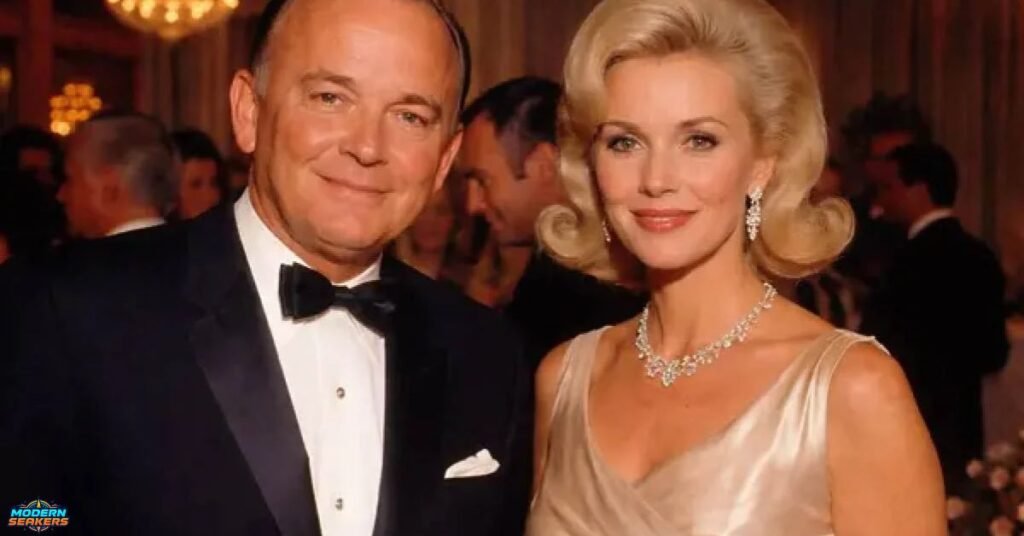
Jane Dobbins Green remains one of the lesser-known figures connected to Ray Kroc and the history of McDonald’s. Born in Walla Walla, Washington, in 1911, she became known publicly through her marriage to Kroc, the business executive who transformed the McDonald’s franchise system into a major force in the fast-food industry. Before that relationship, she was reportedly a professional secretary associated with Hollywood actor John Wayne.
Jane married Kroc on February 23, 1963, and their marriage ended in 1968. Unlike Kroc’s other wives, she largely remained outside media attention. Her later life is less thoroughly documented, making her story a mixture of established historical facts and details that require caution.
Quick Facts About Jane Dobbins Green
| Quick Fact | Details |
| Full Name | Jane E. Dobbins Green Whitney |
| Known As | Jane Dobbins Green |
| Date of Birth | November 22, 1911 |
| Birthplace | Walla Walla, Washington |
| Parents | Warren David Dobbins and Grace Myrtle Duncan |
| Profession | Professional secretary |
| Hollywood Connection | Reportedly worked as John Wayne’s secretary |
| Famous Spouse | Ray Kroc, McDonald’s business executive |
| Marriage to Kroc | February 23, 1963 |
| Divorce | 1968 |
| Second Husband | Paul D. Whitney; reported marriage in 1984 |
| Death & Burial | August 7, 2000; Westwood Memorial Park, Los Angeles, California |
Who Was Jane Dobbins Green?
Jane Dobbins Green was an American woman whose historical significance comes primarily from her connection to two well-known worlds: Hollywood and Ray Kroc’s McDonald’s empire. She was Kroc’s second wife, marrying him during a crucial period in the expansion of his business interests.
Her identity should not be confused with Joan Kroc, Kroc’s third wife and a major philanthropist. Jane’s marriage to Kroc lasted from 1963 to 1968, while Joan married him in 1969 and remained his wife until his death in 1984.
Jane’s story is especially interesting because relatively little personal material survives about her. Unlike Kroc and Joan, she did not become a prominent public personality in her own right.
Early Life and Family Background
Jane was born on November 22, 1911, in Walla Walla, Washington. Historical research identifies her birth name as Jane Elizabeth Dobbins. Her parents are generally identified as Warren David Dobbins and Grace Myrtle Duncan, although some modern online biographies provide conflicting versions of their names and family details.
Very little reliable information is available about Jane’s childhood, schooling, or teenage years. This limitation is important because later biographies sometimes fill those gaps with details that are difficult to verify.
Her early life took place during a period when professional opportunities for women were changing considerably. Secretarial work became an important career path, particularly for women who developed strong administrative skills, organization, correspondence, and discretion.
Family and Personal Background
Jane’s family history is less extensively documented than Ray Kroc’s. Her parents, Warren David Dobbins and Grace Myrtle Duncan, are frequently identified in genealogical accounts, while her later records are associated with the name Jane E. Dobbins Green Whitney.
The limited documentation also explains why contradictory details appear online. Some sources present precise information about siblings, earlier relationships, and family circumstances without providing enough primary evidence to confirm every claim.
One point that can be stated more confidently is that Jane maintained a comparatively private personal life. Her limited public presence makes it difficult to reconstruct every stage of her family history without relying on speculation.
Education and Early Career
No authoritative public record establishes Jane’s formal education in detail. Her professional identity is better documented than her school years.
She is commonly described as a professional secretary, with her career connected to Hollywood. Historical accounts identify her as John Wayne’s secretary, making her work particularly notable because Wayne was one of the most recognizable American actors of his era.
Secretarial work at that level required organization, correspondence management, scheduling, discretion, and the ability to operate around high-profile personalities. These administrative skills provide an important part of Jane’s identity beyond her later marriage to Kroc.
Did Jane Dobbins Green Ever Work Alongside John Wayne?
Yes. The strongest historical accounts identify Jane as a secretary to John Wayne. Ray Kroc himself described her that way in his memoir, and later historical research has repeated the connection.
However, the phrase “personal secretary claim” should be handled carefully. Available sources support the secretary’s connection, but detailed employment dates and a complete description of her responsibilities are not well documented.
There is also no strong evidence that Jane had a major independent Hollywood career as an actress, producer, or studio executive. Her professional contribution appears to have been administrative rather than on-screen.
A Career Built on Professionalism
Jane’s career illustrates how professional women could occupy influential behind-the-scenes positions without becoming public celebrities.
Working as a secretary for a major Hollywood personality required more than routine clerical tasks. The position likely depended heavily on confidentiality, organization, scheduling, correspondence, and professional judgment.
That background also helps explain why her later life generated comparatively little celebrity publicity. Jane’s public identity was connected to famous men, but she herself did not pursue a highly visible media career.
How Jane Dobbins Green Met Ray Kroc
Jane met Ray Kroc during a period when his business ambitions were rapidly developing. Kroc had already moved beyond his earlier career as a paper cup salesman and milkshake machine salesman and was becoming deeply involved with the McDonald brothers’ restaurant concept.
Accounts based on Kroc’s memoir describe an unusually short courtship. Historical research from the Society for American Baseball Research reports that Kroc met Jane in 1963 and married her on February 23 of that year.
Their marriage therefore began during a transformative chapter in Kroc’s professional life.
Who Was Ray Kroc?
Ray Kroc was born on October 5, 1902, in Oak Park, Illinois. He became the businessman most closely associated with turning McDonald’s into a large-scale franchise operation.
Kroc’s early business experience included selling paper cups and later working with Multimixer machines used by restaurants to prepare multiple milkshakes. His encounter with the McDonald brothers in San Bernardino, California, changed the direction of his career.
The McDonald brothers had developed a highly efficient restaurant model. Kroc recognized the potential of standardization and franchise expansion and eventually acquired control of the McDonald’s business and its trademarks.
By the time he married Jane, Kroc was already entering a much larger phase of his career.
A Relationship During a Historic Business Era
Jane’s marriage to Kroc overlapped with a critical period in McDonald’s development. The company was moving from a successful American restaurant concept toward a standardized national and international franchise system.
This historical context is important, but it does not mean Jane was responsible for the company’s expansion. There is no strong evidence identifying her as a McDonald’s executive, franchise architect, or corporate decision-maker.
Her significance lies primarily in being part of Kroc’s personal life while his business became increasingly influential in the fast-food industry.
Marriage to Ray Kroc
Jane and Ray Kroc married on February 23, 1963. Their marriage lasted approximately five years before ending in divorce in 1968.
Jane became Ray Kroc’s second wife following his long marriage to Ethel Fleming. Kroc and Ethel had divorced in 1961 after having one daughter, Marilyn Kroc Barg.
Jane and Kroc did not have children together according to available biographical records. This distinction is important because Jane is sometimes incorrectly identified online as Marilyn Kroc Barg’s mother. Marilyn was Kroc’s daughter from his first marriage to Ethel Fleming.
Life During McDonald’s Expansion
Jane lived with Kroc while McDonald’s was becoming increasingly prominent. During the 1960s, the company’s standardized franchise model expanded rapidly, eventually reaching beyond the United States.
Her position in that history was personal rather than corporate. There is no reliable evidence that she participated directly in the management of McDonald’s or helped develop the franchise system.
That distinction matters because being married to a major business executive does not automatically make someone a business partner.
Why Did Jane Dobbins Green and Ray Kroc Divorce?
The exact private circumstances surrounding the divorce are not fully documented from Jane’s perspective. What is better established is the broader timeline involving Joan Smith, the woman who later became Kroc’s third wife.
Kroc had known Joan before his marriage to Jane. Historical accounts describe their relationship as complicated because both had other marriages during earlier stages of their connection. Their relationship later resurfaced, and Kroc and Jane divorced in 1968. Kroc married Joan Smith in 1969.
Ray Kroc’s Business Commitments
Kroc’s professional life was intensely demanding. McDonald’s was expanding, and his attention remained focused on franchising, corporate development, and the growth of the brand.
However, it would be inaccurate to say that business commitments alone caused the divorce. The available historical record does not provide enough evidence to reduce their separation to one factor.
Changing Personal Relationships
Kroc’s renewed relationship with Joan is an important part of the timeline. Historical accounts based on Kroc’s own recollections indicate that his feelings for Joan remained significant.
Because Jane did not leave behind an extensive public account of the marriage, her personal perspective on these events remains largely unknown.
Jane’s Graceful Response
Claims about Jane’s emotions or exact response to the divorce should be treated cautiously. There is not enough first-person evidence to describe her private feelings as established fact.
What can be said is that she largely disappeared from the public narrative surrounding Kroc after their divorce. Her later life did not attract the same media attention as Joan Kroc’s.
Read More:Julie Farrait: The Untold Story of Frank Lucas’s Wife 2026
Life After the Divorce
After the 1968 divorce, reliable public information about Jane becomes much more limited. This lack of information should not automatically be interpreted as proof that she deliberately avoided all publicity.
Rather, it demonstrates how little first-person material survives about her later years.
Modern biographies often describe her as living a quiet lifestyle, but the safest historical conclusion is simply that her public documentation was limited.
A New Beginning with Paul D. Whitney
Genealogical and memorial records commonly associate Jane with the name Jane E. Dobbins Green Whitney and report a 1984 marriage to Paul D. Whitney.
However, this later marriage is not documented as extensively as her relationship with Kroc. For that reason, the 1984 marriage is best described as a reported part of her later biography rather than an extensively documented public event.
The limited evidence surrounding Paul D. Whitney also reinforces how private Jane’s post-Kroc life appears to have been.
Death and Final Resting Place
Jane is commonly reported to have died on August 7, 2000, in Los Angeles, California, at age 88. Genealogical and memorial sources associate her burial with Westwood Memorial Park in Los Angeles.
The exact cause of death is not sufficiently established in the strongest sources reviewed. Some online profiles describe natural causes, but that detail should not be presented as confirmed without stronger documentation.
Her reported resting place is therefore Westwood Memorial Park rather than the San Diego burial location associated with Ray Kroc.
Jane Dobbins Green’s Net Worth
There is no reliably documented figure for Jane’s personal net worth.
Online estimates sometimes attach specific dollar amounts to her name, but those figures generally lack supporting estate records, financial statements, verified property records, or a documented divorce settlement.
It is therefore more accurate to describe her wealth as unknown than to repeat a speculative number.
Kroc eventually accumulated substantial wealth through McDonald’s, but his fortune cannot simply be transferred to Jane. Their marriage ended in 1968, approximately 16 years before his death.
Ray Kroc’s Three Marriages Compared
Ray Kroc’s three marriages represent three distinct periods of his personal life.
| Wife | Marriage | Historical connection |
| Ethel Fleming | 1920s–1961 | First wife and mother of Marilyn Kroc Barg |
| Jane Dobbins Green | 1963–1968 | Second wife during McDonald’s major expansion |
| Joan Smith Kroc | 1969–1984 | Third wife and later prominent philanthropist |
Jane’s position in Ray Kroc’s three marriages is sometimes overlooked because her marriage was considerably shorter than his first and because Joan became much more publicly recognized through philanthropy.
Joan Kroc later became known for substantial charitable giving, making her a much more visible figure in discussions of Kroc’s legacy.
Why Was Jane Dobbins Green Left Out of The Founder?
The Founder (2016 film), starring Michael Keaton as Ray Kroc, concentrates primarily on the transformation of McDonald’s, Kroc’s relationship with the McDonald brothers, and the business conflicts surrounding the franchise system.
Jane does not receive a substantial role in the film.
The Film Prioritized Corporate History
The movie had to compress decades of corporate history into a feature-length narrative. Its central storyline focuses on Kroc’s transformation from salesman into the dominant figure associated with McDonald’s.
Jane’s five-year marriage was not central to that corporate history.
Jane Left Few Public Records
Another factor is the limited amount of surviving public material about Jane herself. Unlike Kroc, she did not publish a major memoir or become a major public personality.
That makes her more difficult to portray as a fully developed historical character without adding fictional material.
Historical Focus Over Personal Biography
The film’s focus was business history rather than a complete account of every relationship in Kroc’s life.
Consequently, Jane’s absence should not be interpreted as proof that her marriage did not happen or that she was unimportant to Kroc’s personal history. It reflects the selective nature of a biographical film.
Jane Dobbins Green’s Legacy
Jane’s legacy is unusual because it is defined as much by what is unknown as by what is documented.
She was connected to Hollywood through John Wayne, became Ray Kroc’s second wife, and lived during the period when McDonald’s developed into a powerful franchise brand.
At the same time, she did not become a public business figure, philanthropist, or celebrity personality on the scale of Joan Kroc.
Her story also highlights a broader issue in celebrity biography: privacy can leave major gaps in the historical record. Those gaps should not be filled with invented details.
Final Thoughts
Jane Dobbins Green occupies a small but meaningful place in the history surrounding Ray Kroc and McDonald’s. Born in Walla Walla, Washington, she developed a professional career as a secretary before entering Kroc’s life in the early 1960s.
Her marriage to Kroc began on February 23, 1963, and ended in 1968. Although their relationship overlapped with one of the most important periods of McDonald’s franchise expansion, there is no strong evidence that Jane played a corporate role in the company.
Her later life, reported marriage to Paul D. Whitney, death in 2000, and burial at Westwood Memorial Park remain less thoroughly documented. That limited record is precisely why separating established facts from net worth speculation and other unverified claims is essential when discussing her life.
FAQs about Jane Dobbins Green
Who was Jane Dobbins Green?
Jane Dobbins Green was an American professional secretary and Ray Kroc’s second wife. She reportedly worked as John Wayne’s secretary before marrying Kroc in 1963.
When did Jane Dobbins Green marry Ray Kroc?
Jane married Ray Kroc on February 23, 1963. Their marriage lasted about five years and ended in divorce in 1968.
Did Jane Dobbins Green have children?
No children are documented from Jane’s marriage to Ray Kroc. Kroc’s documented daughter, Marilyn Kroc Barg, was born during his first marriage to Ethel Fleming.
Who was Jane Dobbins Green’s second husband?
Paul D. Whitney is commonly identified as Jane’s later husband. Genealogical and memorial sources report that they married in 1984, although details of this relationship are less thoroughly documented.
Did Jane Dobbins Green work for John Wayne?
Yes. Historical accounts identify Jane as John Wayne’s secretary. Kroc’s memoir and later biographical research both support this professional connection.
Why wasn’t Jane Dobbins Green featured in The Founder?
The Founder focused on Kroc’s business story and selected personal relationships. Jane’s five-year marriage was omitted from the film’s main narrative, which condensed decades of history into a feature-length story.
Where is Jane Dobbins Green buried?
Westwood Memorial Park in Los Angeles, California, is commonly reported as Jane’s final resting place. Genealogical records support this location, although the broader documentation of her later life is limited.

Charlotte Jones is the admin of ModernSeakers.com, a celebrity-focused platform covering celebrity profiles, entertainment updates, lifestyles, and fascinating stories about personalities from around the world.

1 thought on “Jane Dobbins Green: Ray Kroc’s Second Wife Revealed 2026 ”